
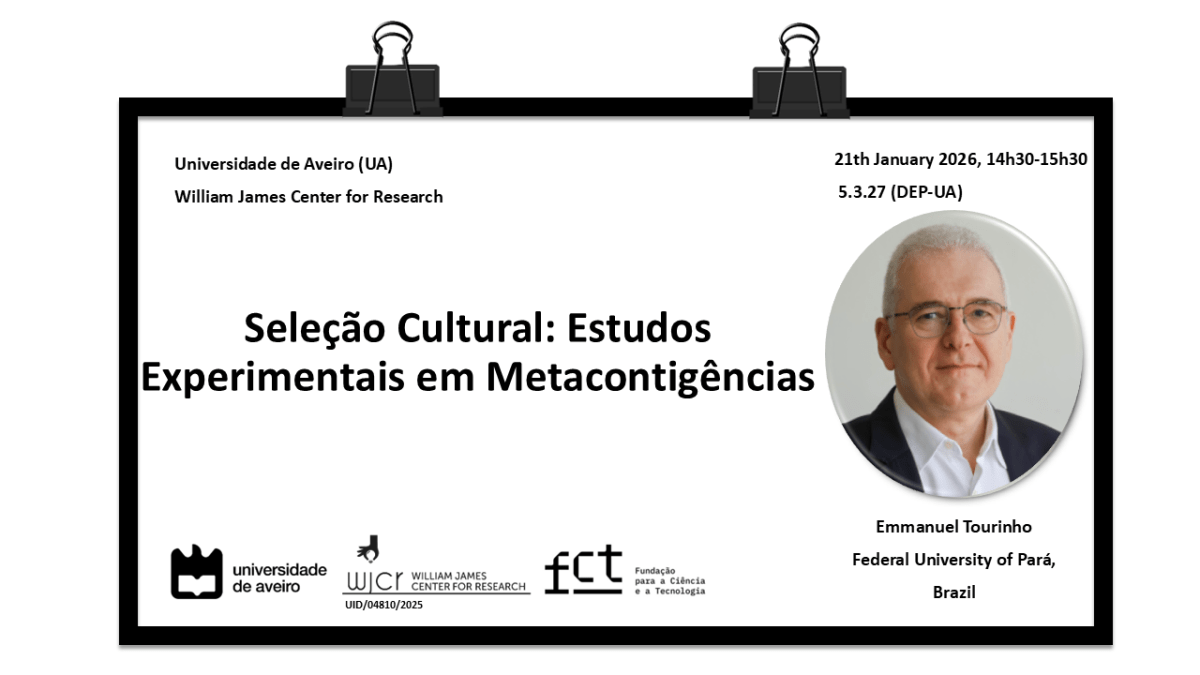
Prof. Dr. Emmanuel Tourinho (Federal University of Pará, Brazil) will give a lecture entitled “Cultural Selection – Experimental Studies in Metacontingencies”.
About the Speaker:
Dr. Emmanuel Zagury Tourinho holds a Ph.D. in Psychology (Experimental Psychology) from the University of São Paulo (1994). He is a Full Professor at the Federal University of Pará (UFPA), where he teaches in the Graduate Program in Behavior Theory and Research. He is a CNPq Research Productivity Fellow (Level C), and has recently served as Rector of UFPA (2016-2024), after a period of serving as UFPA’s Vice-Rector for Research and Graduate Studies (2009-2016). He has also served as Coordinator of the Psychology Advisory Committee of CNPq (2014-2016), Coordinator of the Area of Psychology at CAPES (2008-2010), President of the National Association of Rectors of Federal Institutions of Higher Education, ANDIFES (2017-2018), and President of the International Cooperation Group of Brazilian Universities, GCUB (2022-2024).
When/Where: 21th January 2026, 14h30, at Universidade de Aveiro (Room 5.3.27 DEP-UA).
Abstract:
Culturo–Behavioral Science (CBS) is a research field within Behavior Analysis that examines the evolution of cultural practices from a selectionist perspective. Its conceptual framework includes the proposal of the metacontingency as the unit of analysis of selection at the cultural level, which has underpinned both the examination of concrete societal issues and experimental investigation. Within the metacontingency framework, cultural–behavioral phenomena are treated as supra-organismic, that is, involving the coordinated behaviors of multiple individuals who constitute a cultural system or subsystem (interlocking behavioral contingencies – IBCs). Experimental studies have been conducted using “laboratory microcultures” and have generated relevant information about the evolution of practices in cultural systems, beginning with evidence that the probability of recurrence of IBCs and their aggregate products varies as a function of consequences delivered by an external selecting environment, including, under certain conditions, situations in which there is a conflict between what yields the best outcome for the group and what yields the best outcome for the individual.
 WJCR
WJCR 