
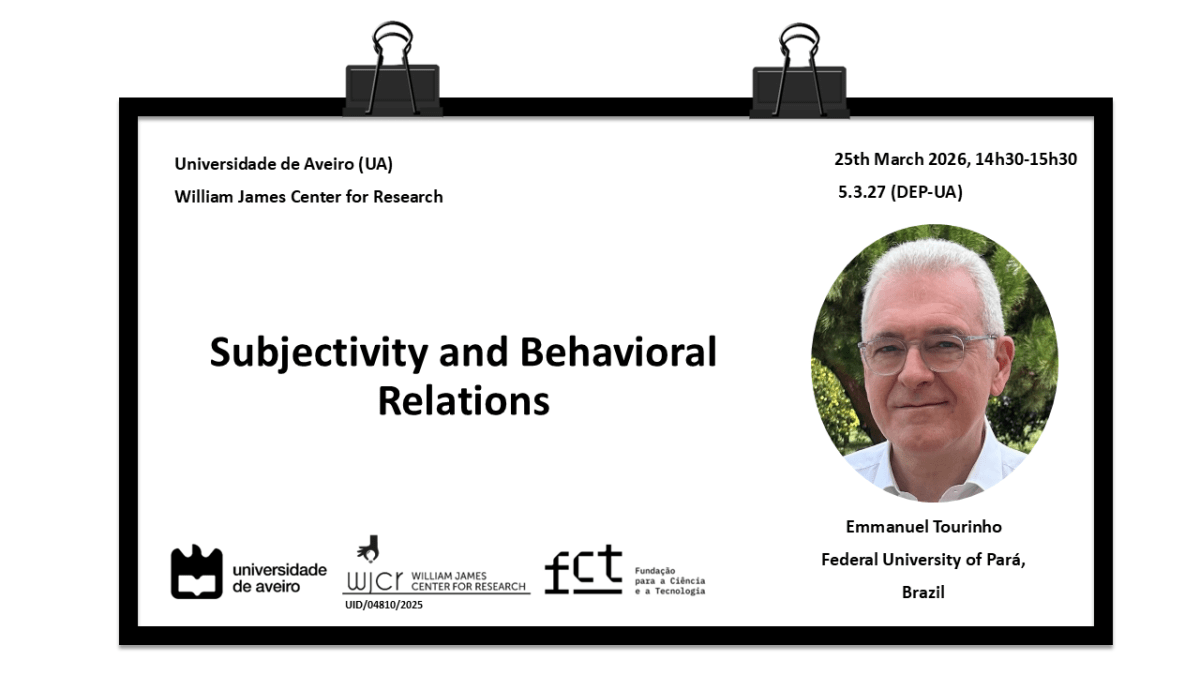
Prof. Dr. Emmanuel Tourinho (Federal University of Pará, Brazil) will give a lecture entitled “Subjectivity and Behavioral Relations”.
About the Speaker:
Dr. Emmanuel Zagury Tourinho holds a Ph.D. in Psychology (Experimental Psychology) from the University of São Paulo (1994). He is a Full Professor at the Federal University of Pará (UFPA), where he teaches in the Graduate Program in Behavior Theory and Research. He is a CNPq Research Productivity Fellow (Level C), and has recently served as Rector of UFPA (2016-2024), after a period of serving as UFPA’s Vice-Rector for Research and Graduate Studies (2009-2016). He has also served as Coordinator of the Psychology Advisory Committee of CNPq (2014-2016), Coordinator of the Area of Psychology at CAPES (2008-2010), President of the National Association of Rectors of Federal Institutions of Higher Education, ANDIFES (2017-2018), and President of the International Cooperation Group of Brazilian Universities, GCUB (2022-2024).
When/Where: 25th March 2026, 14h30, at Universidade de Aveiro (Room 5.3.27 DEP-UA).
Abstract:
Cognitions and emotions are considered psychological phenomena, but are often seen as beyond the scope of a science of behavior. This assumption is usually associated with four classic psychological dichotomies: public/private, objective/subjective, internal/external, physical/mental, according to which cognitions are private, subjective, and/or mental; and emotions are private, subjective, and/or internal. For Behavior Analysis, however, behavioral relations constitute the subject matter of Psychology, and this is the nature of cognitive and emotional phenomena. To interpret them, Behavior Analysis uses the concepts of private events, private stimuli, and covert responses, which highlight restricted observability as a differentiating aspect in some cognitive and emotional phenomena. Furthermore, instead of a simple distinction between public and private, one can work with the notion of a continuum of observability of stimuli, responses, and behavioral relations. Concepts from ordinary language that describe emotions, in turn, refer to phenomena with varying degrees of complexity, encompassing behavioral relationships resulting from phylogenetic, ontogenetic, and cultural histories.

