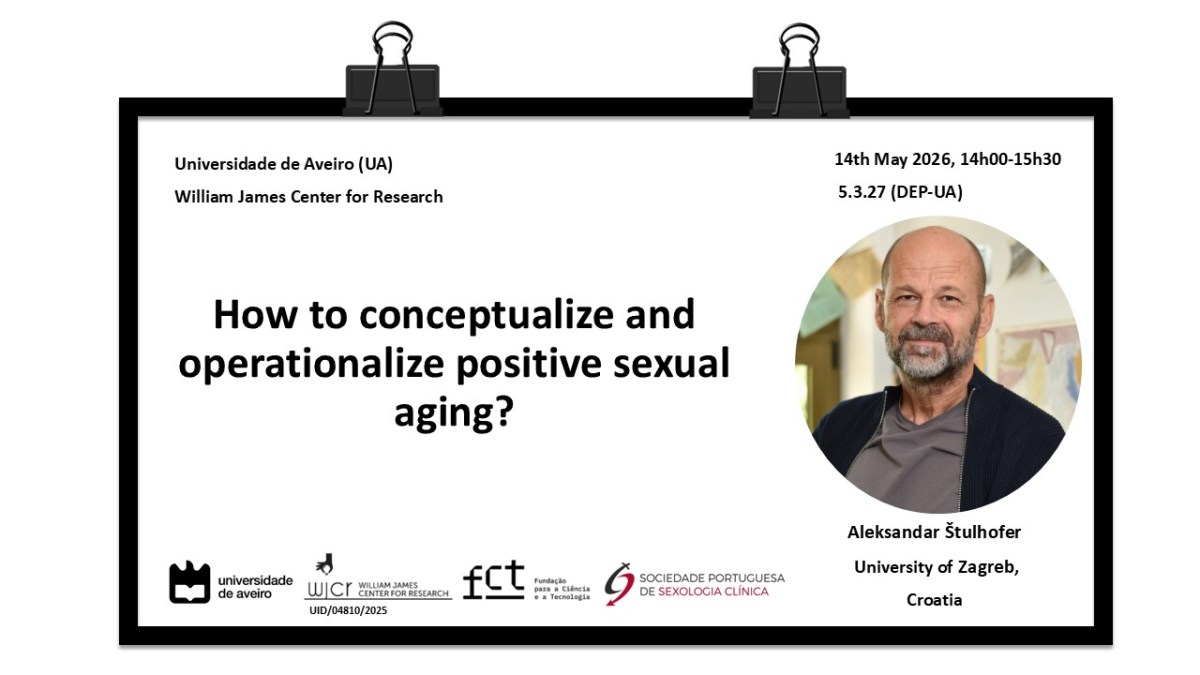
Prof. Dr. Aleksandar Štulhofer (University of Zagreb, Croatia) will give a lecture entitled “How to conceptualize and operationalize positive sexual aging?”.
About the Speaker:
Dr. Aleksandar Štulhofer is a Full Professor of Sociology at the University of Zagreb. His research focuses on human sexuality, sexual health, intimate relationships, and the social determinants of sexual behavior. He has led and contributed to numerous international projects examining adolescent sexual development, pornography use, and sexual well-being, using large-scale survey and longitudinal methods. His work is widely published in leading journals in sexuality research and public health, and he has extensive experience in doctoral supervision and international research collaboration.
When/Where: 14th May 2026, 14h00, at Universidade de Aveiro (Room 5.3.27 DEP-UA) and online.
Abstract:
Increasingly, individuals in Western countries are living into old age and placing a higher value on sexuality than previous generations of older adults. The emerging research into sexual aging has provided descriptions of older adults’ patterns of sexual activity, indicating the importance of (largely undefined) positive sexual aging. However, conceptualizations and theoretical models that would organize the descriptions and provide a framework for understanding responses to aging-related changes in sexuality are missing. Building on the successful aging paradigm and the associated process-focused elaborations, the current study presents a novel conceptualization-that of Successful Sexual Aging (SSA)-based on three psychosocial processes (Acceptance, Adaptation, and Opportunities) and their interrelatedness. The concept is non-normative (SSA is not necessarily dependent on being sexually active) and is hypothesized to be qualified by master statuses, including age, gender, relationship status, and sexual orientation. Initial empirical support for the SSA model, which has been provided by a recent cross-cultural operationalization and its validation, suggests the model’s potential to contribute to the public promotion of positive attitudes toward sexual aging, assist in designing sexuality information and education programs for older adults, and inform professionals who work with and care for older adults.
Online access: Available soon
 WJCR
WJCR 