
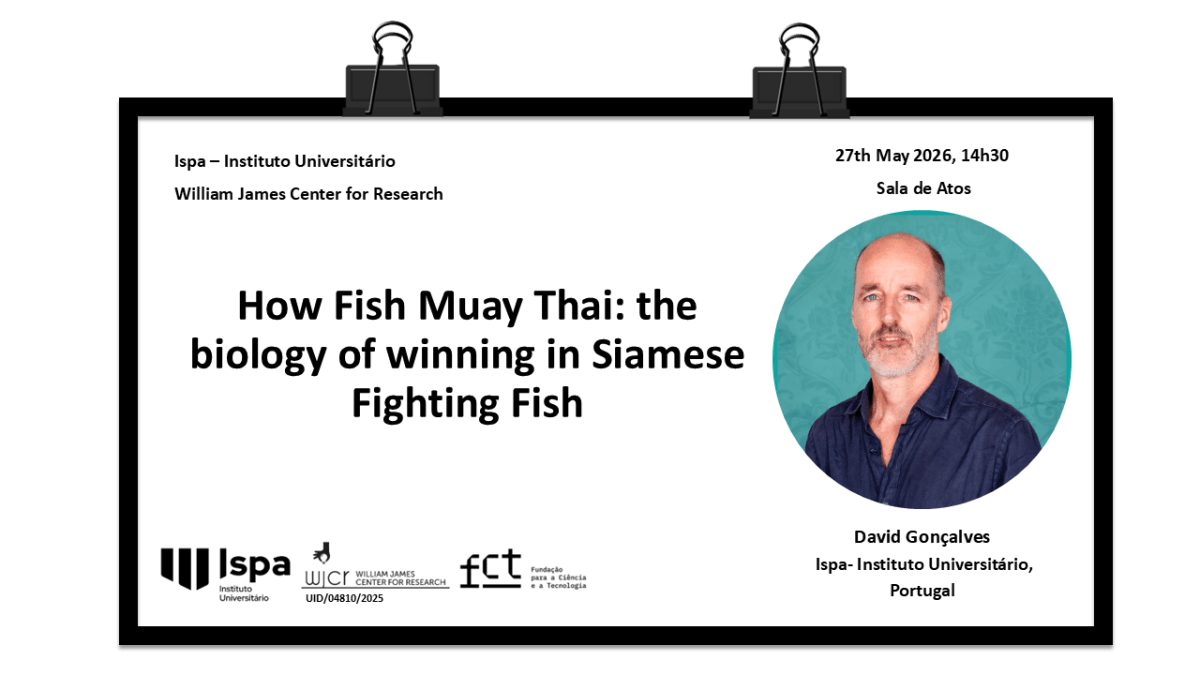
Prof. Dr. David Gonçalves (Ispa – Instituto Universitário, Portugal) will give a lecture entitled “Fish Muay Thai: the Biology of Winning in Siamese Fighting Fish”.
About the Speaker:
Dr. David Gonçalves is an Associate Professor at ISPA – Instituto Universitário. His research focuses on the physiological mechanisms and evolutionary implications of animal behavior, with particular emphasis on the genomic and neuroendocrine bases of behavioral plasticity and adaptation. He has worked extensively with fish models, including the blenny Salaria pavo, the Siamese fighting fish Betta splendens, and the marine medaka Oryzias melastigma, to investigate how hormones and genes shape social and reproductive behaviors. His integrative approach combines methods from ethology, endocrinology, molecular biology, neuroscience, immunohistochemistry, and transcriptomics. More recently, he has been incorporating deep-learning tools to improve behavioral quantification methods in fish.
When/Where: 27th May 2026, 14h30, at Ispa – Instituto Universitário, (Sala de Atos).
Abstract:
Although aggressive behavior influences outcomes across a wide range of human and animal contexts, its biological foundations remain largely unresolved. Addressing this complexity requires an integrative perspective that links behavior to underlying biological processes, from genetics to neural circuitry.
In this lecture, David Gonçalves will demonstrate how centuries of artificial selection in Southeast Asia have turned Betta splendens into an ideal “natural experiment” for the study of aggression. The presentation will discuss evidence showing how selection has shaped motivation, fighting strategies, endocrine regulation, and even the composition of the gut microbiota in these organisms. The aim is to provide a detailed view of how complex behavioral traits emerge from interactions among different neurobiological systems, revealing general principles that may help explain variation in aggressive behavior across species.

