
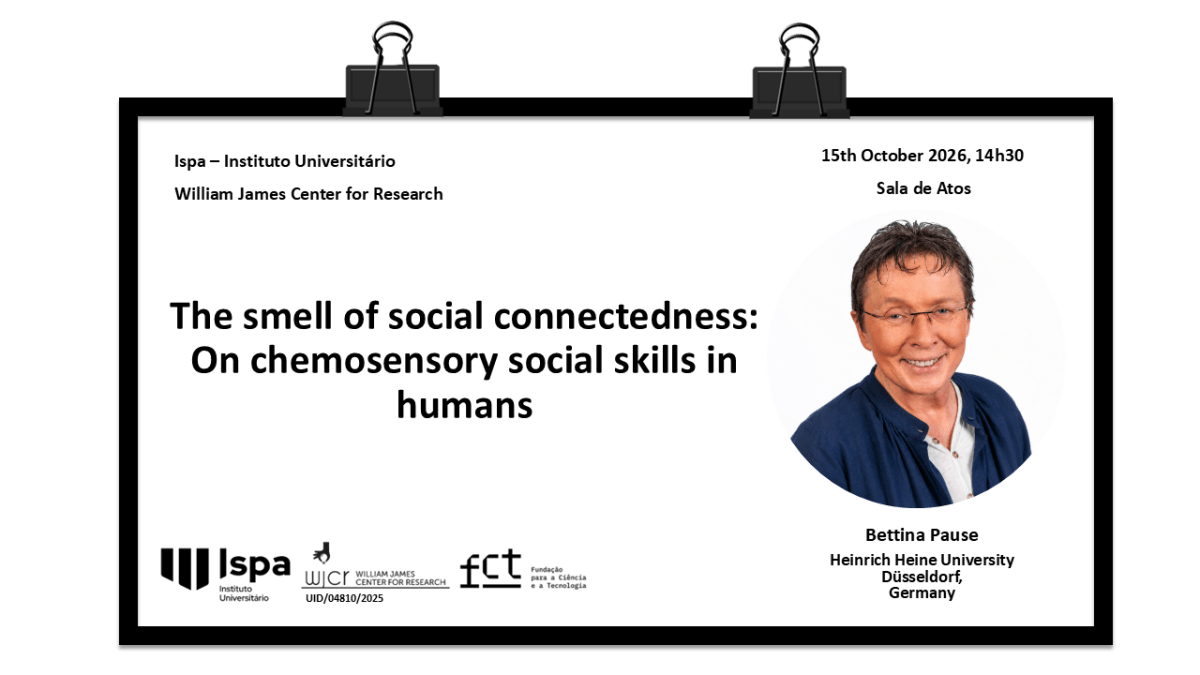
Prof. Dr. Bettina Pause (Heinrich Heine University Düsseldorf, Germany) will give a lecture entitled “The smell of social connectedness: On chemosensory social skills in humans”
About the Speaker:
Dr. Bettina Pause is a Professor of Biological Psychology at Heinrich Heine University Düsseldorf, Germany. Her research focuses on olfactory information processing and social communication through chemical signals. The author of more than 100 scientific publications, she has conducted internationally recognized research and has received several distinctions, including the Reinhard-Heynen and Emmi-Heynen Prize for her scientific contributions.
When/Where: 15th October 2026, 14h30, at Ispa – Instituto Universitário (Sala de Atos).
Abstract:
Human olfaction appears to be remarkably acute, functioning at a level comparable to that of other mammals. Humans convey a wealth of information through social volatile substances associated with biological and psychological states and characteristics. Chemosensory signals convey information about an individual’s genetic profile, sex, age, nutritional and health status, personality traits, and emotional state.
The chemosensory communication of emotions has been studied in considerable detail in recent years. Humans are capable of transmitting signals of stress, fear, anxiety, disgust, aggression, and happiness through social volatile compounds. However, the impact of chemosensory signals varies depending on the characteristics of both the sender and the receiver, such as gender, hormonal status, and neural state. Interestingly, multisensory research has shown that, in situations of perceptual ambiguity, chemosensory information can override social signals conveyed through other sensory channels. Particularly in humans, the messages conveyed by chemosensory signals cannot easily be falsified and may therefore represent honest signals. Moreover, chemosensory communication often operates below the threshold of conscious attention, significantly limiting the receiver’s ability to intentionally regulate its emotional impact.
Overall, through chemical signals, humans are able to distinguish between safe and threatening social relationships. Ontogenetically and phylogenetically harmful conditions, such as social stress, aggression, illness, or hunger, are avoided. Conversely, chemosensory messages associated with social safety, such as happiness, encourage social approach behaviours due to the contagious nature of chemosensory happiness.
It can therefore be concluded that, in humans, chemosensory messages may represent honest signals and thus constitute highly valid indicators of the consequences of social encounters. The extent to which olfaction contributed to the development of the social brain, thereby creating the prerequisite for social connection, will be discussed.
 WJCR
WJCR 