
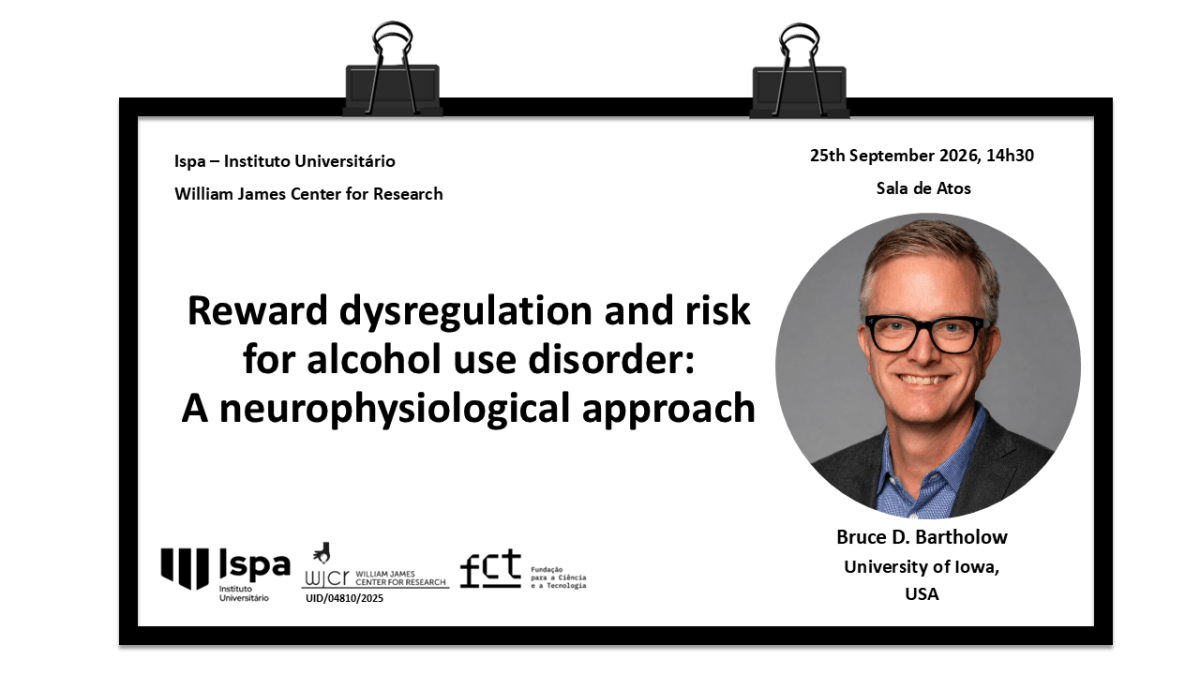
Prof. Dr. Bruce D. Bartholow (University of Iowa, USA) will give a lecture entitled “Reward dysregulation and risk for alcohol use disorder: A neurophysiological approach.”
About the Speaker:
Dr. Bruce D. Bartholow earned his PhD in Psychology from the University of Missouri (USA) in 2000. He is currently a Professor at the University of Iowa, having previously taught at the University of North Carolina and the University of Missouri. His research focuses on the cognitive and motivational mechanisms underlying problematic behaviors, such as excessive alcohol consumption and intergroup discrimination. He is the author of approximately 170 scientific publications, has received several research awards, and is a member of leading international psychological associations.
When/Where: 25th September 2026, 14h30, at Ispa – Instituto Universitário (Sala de Atos).
Abstract:
Prominent theoretical models propose that addiction results from dysfunction in one or more domains of functioning, typically including executive or cognitive control, incentive salience, and negative emotionality.
Incentive salience reflects the outcome of a learning process through which individuals associate rewarding experiences—such as increased pleasure or reduced pain or stress—with alcohol or other drug use. It is manifested in cognitive-motivational responses to visual cues associated with drug use. This research examines how incentive salience interacts with both cognitive control and the motivational significance of natural, non-drug rewards to determine the risk of alcohol use disorder and related problems. The findings draw on multiple samples, ranging from adolescents (ages 14–17) to emerging adults (ages 18–20) and young adults (ages 21–30), with varying levels of alcohol consumption and associated problems.
Overall, the findings converge on the idea that a dysregulated response to reward—characterized by strong incentive salience, weak cognitive control, and reduced motivation for natural rewards—confers a heightened risk of alcohol-related problems.

